
Case Study: X Growth Engine
X Growth Engine has a highly practical value proposition: a Chrome extension that sits quietly on your X feed and uses Grok to filter, score, and surface the high-value conversations in your niche.
The tool is strong, and anchoring the AI power specifically to Grok is an excellent, native positioning choice. The issue was that the landing page focused too heavily on in-app analytics and manual tasks, presenting itself as a reporting tool rather than a high-ROI lead generation engine. Here is how we evaluated the page, analyzed the scrolling fatigue of solo creators, and reframed the hero to sell an ambitious outcome while addressing deep trust objections.
Part 1: The First AI Pass
We ran the initial automated crawl to strip away any styling assumptions and establish the functional parameters of X Growth Engine:
- What it is: A Chrome extension designed to monitor a user’s X feed and leverage Grok to highlight niche conversations worth replying to.
- The core mechanism: It processes public feed posts, bundles opportunities into batches, offers suggested reply angles, and maintains safety by letting the user handle the actual posting.
- Pricing: A Free tier (observes feed, caps at 1,000 posts captured, daily recaps) and an Early Access tier at $30/month (100,000+ posts captured, Grok opportunity batches, suggested reply angles, and niche targeting).
This initial pass highlighted a clear division. Structurally, the extension is a low-friction assistant. However, the landing page layout was treating the service like an analytical reporting platform rather than an active prospect pipeline.
Part 2: Targeting the Weary Builder
To identify the emotional leverage point, we looked closely at the primary audience: the SaaS Founder & Solo Creator. We’ll call him Martin [1].
Martin’s biggest issue isn’t finding another metrics dashboard. He is suffering from severe weariness—the exhausting, repetitive loop of scrolling, commenting, and posting on X for zero trackable ROI [1]. He feels the social pressure to stay active on the platform, but the manual grind is actively eating into his development time [1].
Part 3: Finding Martin’s Voice on Reddit
We crawled r/SaaS to isolate the verbatim phrases that founders use when discussing their marketing efforts on X [1].
One central theme emerged: the manual bottleneck [1].
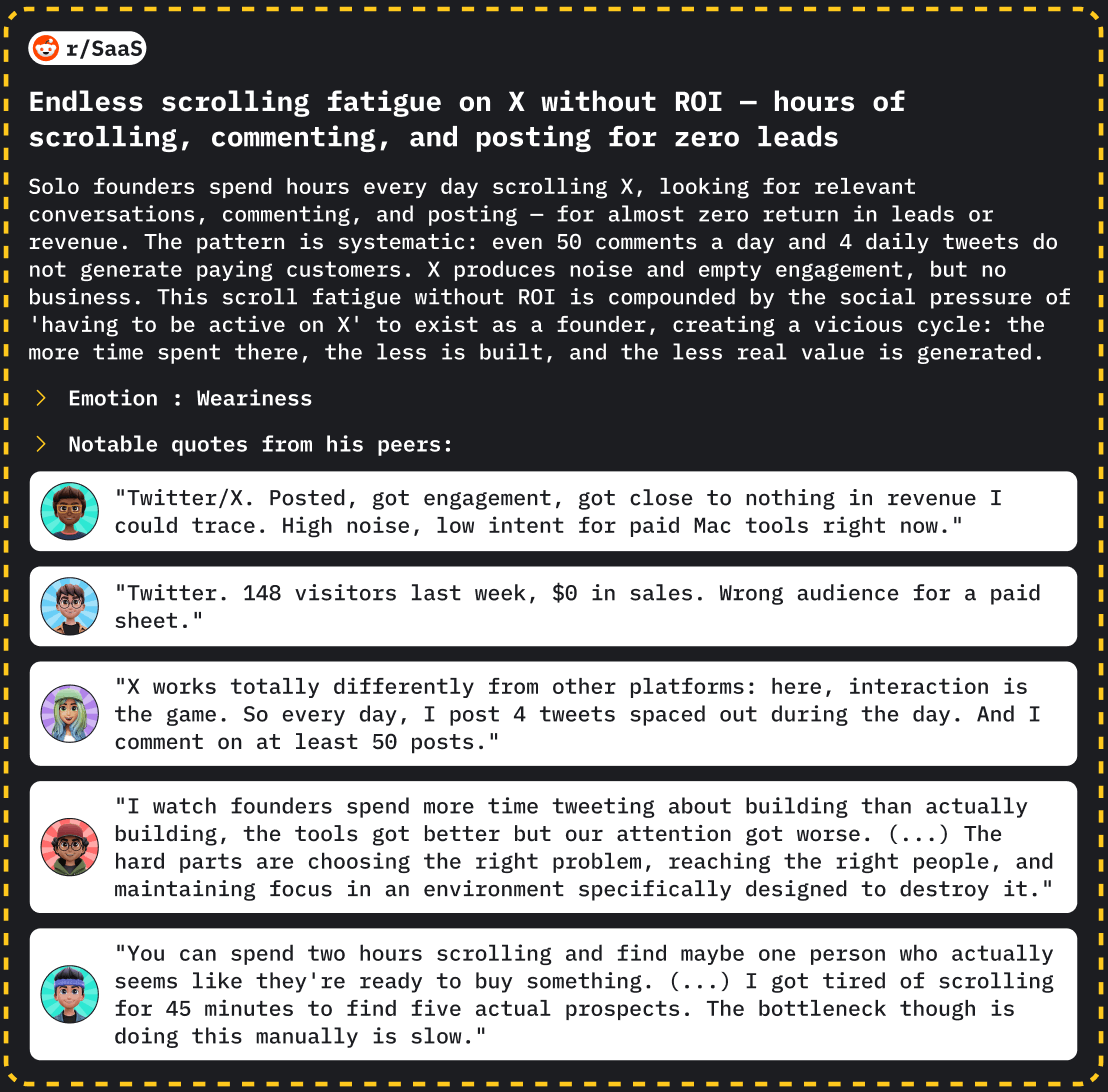
The complaints we analyzed were highly consistent:
“Twitter/X. Posted, got engagement, got close to nothing in revenue I could trace. High noise, low intent for paid Mac tools right now.” [1]
“Twitter. 148 visitors last week, $0 in sales. Wrong audience for a paid sheet.” [1]
“X works totally differently from other platforms: here, interaction is the game. So every day, I post 4 tweets spaced out during the day. And I comment on at least 50 posts.” [1]
“You can spend two hours scrolling and find maybe one person who actually seems like they’re ready to buy something… I got tired of scrolling for 45 minutes to find five actual prospects. The bottleneck though is doing this manually is slow.” [1]
Martin doesn’t want “Feed Analytics” to confirm he has scrolled past 10,000 posts. He is exhausted by the manual search [1]. He wants a fast, automated way to extract high-intent prospects out of the chaos.
Part 4: Reading the Page Through Martin’s Eyes
When we assessed the landing page with Martin’s mindset, we noted key areas where the copy and layout fell short:
- Selling a Task vs. Selling an Outcome: The original headline (“Stop Scrolling Past Conversations Worth Your Reply on X”) focuses heavily on the task of replying. It feels like an administrative chore.
- Incorrect Feature Hierarchy: The features section focused largely on passive “Feed Analytics” and “Recaps.” This is a critical mistake: it makes a lead-generation engine look like a reporting tool. The highest-value features—“Grok Opportunity Batches” and “Suggested Replies”—were buried at the bottom.
- Friction in the CTAs and Navigation: The “Blog” link in the menu was distracting for an early-stage site with minimal content. Additionally, the hero featured redundant labels, and the bottom section lacked a cohesive secondary CTA, replacing it with a simple email capture form.
- Missing Visual Proof: The page lacked an interactive presentation or clear visual display showing the product in action, which is essential for establishing quick credibility.
Part 5: The Three-Way Review (Our Full Board)
We combined our insights with a structural evaluation from our AI teammate, Tim, to outline a clear set of adjustments:
What’s already working
- Aymeric on Grok integration: “Highlighting Grok is clever. It makes the AI element concrete instead of generic, keeping the entire value proposition native to the X ecosystem.”
- Aymeric on positioning: “The choice to not write replies automatically is excellent. It frames X Growth Engine as a supportive copilot rather than a spam bot, which builds trust.”
- Yoanna on trust-building: “The ‘How It Works’ section is clean and easy to follow. We just need to make the download CTA stand out more.”
What we’d review
- Aymeric on hierarchy: “The feature order needs to be flipped. We must highlight ‘Opportunities’ first, followed by ‘Feed Analytics’ and ‘Interaction History.’ This shifts the perceived value from reporting to active lead generation.”
- Yoanna on menu clutter: “Move the ‘Blog’ link to the footer to keep visitors focused on the main conversion funnel. Also, add a clear FAQ section before the final CTA to resolve objections.”
- Tim on safety concerns: “Chrome extensions that interact with X feeds trigger immediate fears of account suspension. We must explicitly address account safety and the lack of automated bot behavior directly beneath the primary checkout point.”
Restructuring the Page Flow
To maximize impact, we mapped out a logical layout to address the buyer’s skepticism step-by-step:
- Hero (Framed around opportunity generation)
- Product Presentation (Visual mockup or short video)
- The Pain (Scrolling fatigue & low-ROI engagement)
- How It Works (Three straightforward steps)
- Core Value Propositions (Grok Batches & Suggested Replies first)
- Pricing (Simplified free/paid options)
- Social Proof & Authority (Promoting the builder’s profile to build connection)
- FAQ Section (Addressing data encryption and account safety concerns)
- Final CTA (Consistent with the primary value offer)
Part 6: The Hero We Shipped
Using these insights, we reshaped the hero section to focus on an ambitious, life-changing outcome rather than an administrative task:
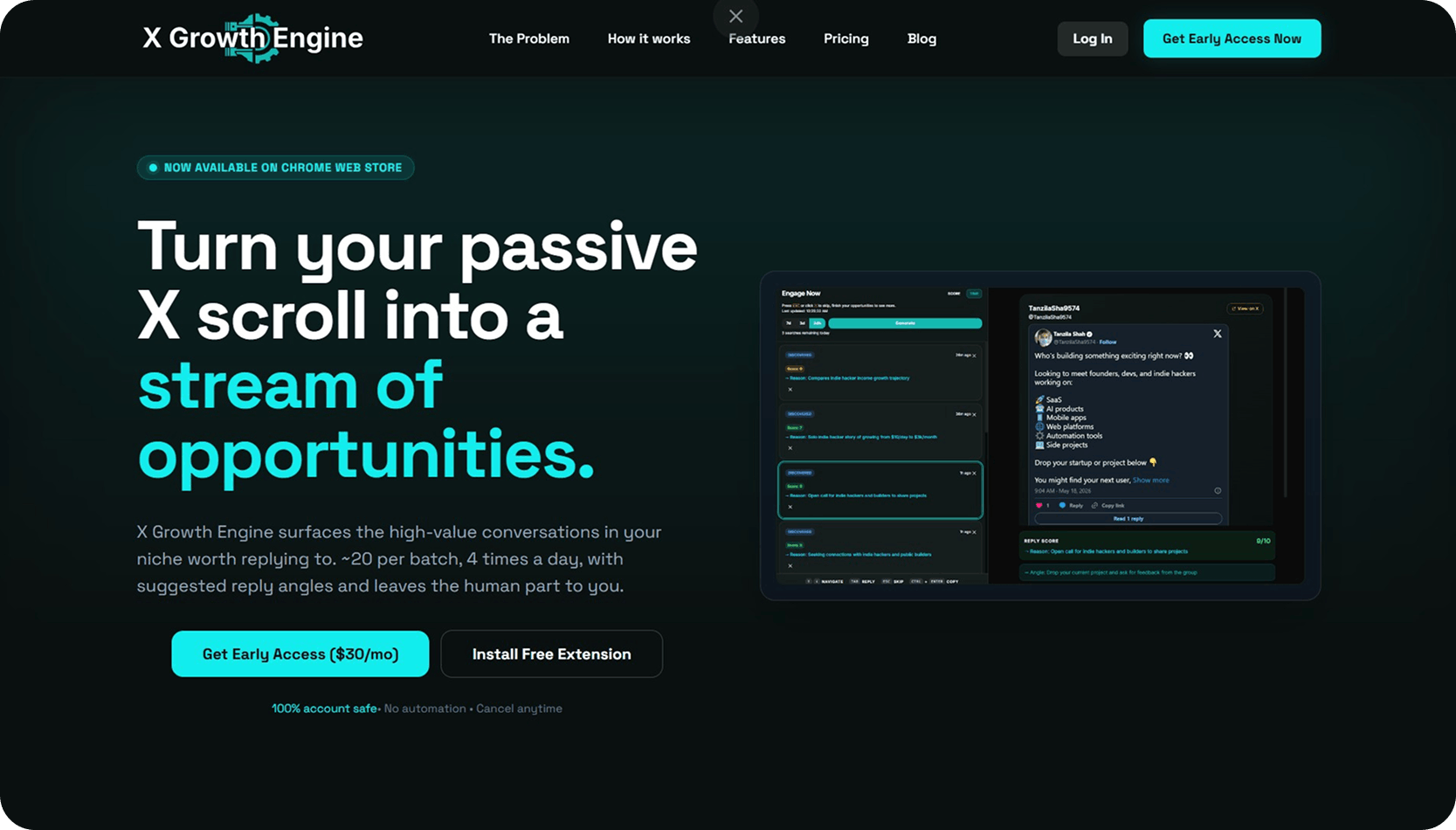
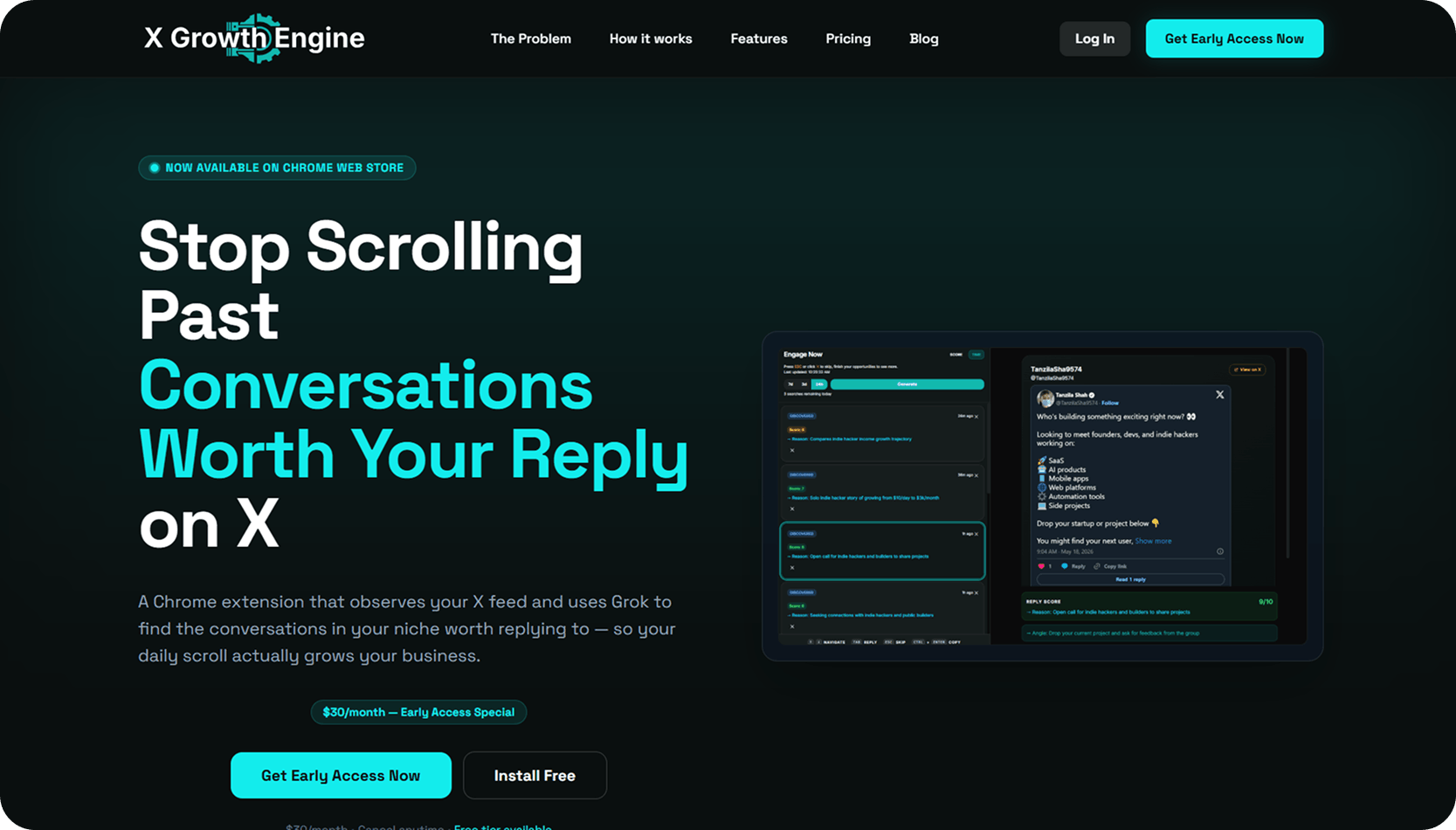
H1: Turn your passive X scroll into a stream of opportunities.
Subhead: X Growth Engine surfaces the high-value conversations in your niche worth replying to. ~20 per batch, 4 times a day, with suggested reply angles—and leaves the human part to you.
Primary CTA: Get Early Access ($30/mo) Secondary CTA: Install Free Extension Trust Line: 100% account safe · No automation · Cancel anytime
Why this changes the game
- We sell an outcome, not a task: Changing “Stop Scrolling Past Conversations…” to “Turn your passive scroll into a stream of opportunities” moves the conversation from manual labor to clear financial upside.
- Clear expectations on output: The subhead tells Martin exactly what he gets (~20 highly filtered opportunities, 4 times a day, with reply angles), making the value proposition tangible.
- Proactive objection handling: Placing “100% account safe · No automation” directly below the CTA immediately reassures users who are terrified of getting their X accounts suspended for using automation tools.
- Harmonized CTAs: The clean pricing button simplifies the decision-making process right from the first interaction.
See the Full Audit
All of these visual annotations, structural reorderings, and copywriting adjustments are designed to be immediately actionable. Here is the complete interactive board we delivered to the team:
The Takeaway for Builders
If your software works inside another ecosystem (like X, LinkedIn, or Slack), your conversion rate relies heavily on addressing platform trust and safety concerns.
If users fear that your tool will get their account banned, no list of features will convince them to convert. Address their security anxieties directly, move passive analytics features below your active core utility, and pitch an ambitious outcome instead of another task to manage.