
Case Study: RankQuest
RankQuest is built on an excellent premise: a gamified SEO system that gives founders and small teams one clear action to take at a time, replacing overwhelming metrics with step-by-step guidance.
The problem wasn’t the mechanics of the product—which clever loop concepts like “quests” and “dungeons” support. The issue lay in the page’s messaging and structure. It spoke an internal jargon (selling “decisions” and “DSL”) rather than the natural language of its users, and presented a confusing section order. Here is how we audited RankQuest, aligned it with a real search marketer’s core anxiety, and reframed the hero to instantly elevate its perceived value.
Part 1: The First AI Pass
We always begin by running a raw crawl of the URL. This allows us to map the functional baseline of the software before our team layers in any psychological analysis:
- What it is: A gamified automated SEO copilot that replaces standard analytics dashboards with singular, sequential decisions and implementation steps.
- The core idea: Observe the site, pinpoint exactly one technical or content issue (e.g., a missing canonical tag), provide step-by-step implementation, and re-evaluate once fixed.
- Pricing: A 7-day free trial, followed by Single Site at $49/month (1 project, full decision engine, implementation rooms) or Multi Site at $129/month (up to 3 projects).
The mechanic is incredibly smart. It shifts the user’s cognitive load from analyzing data to simply executing a task. But the page was explaining the system’s architecture instead of highlighting the financial and emotional payoff.
Part 2: Drowning in Dashboards
From the feature set, the copy engine targeted a very specific pain point within the SEO landscape: analysis paralysis.
Traditional SEO tools dump an endless backlog of “critical priorities” on users without providing contextual steps. This creates a specific buyer profile: Martin, the Solo Founder or Small Agency Owner [0].
Martin doesn’t have the time to become an SEO master. He’s overwhelmed by metrics from Semrush, Ahrefs, and Google Search Console. He doesn’t wake up wishing for a new chart. He wakes up with a single, urgent question: “What do I need to fix first to actually get calls?” [0]
Part 3: Finding Martin’s Voice on Reddit
To ensure we captured the correct language, we used our research extension to crawl r/SaaS and r/SEO, searching for real rants from founders struggling with standard SEO practices [0].
We found an overwhelming theme of confusion:
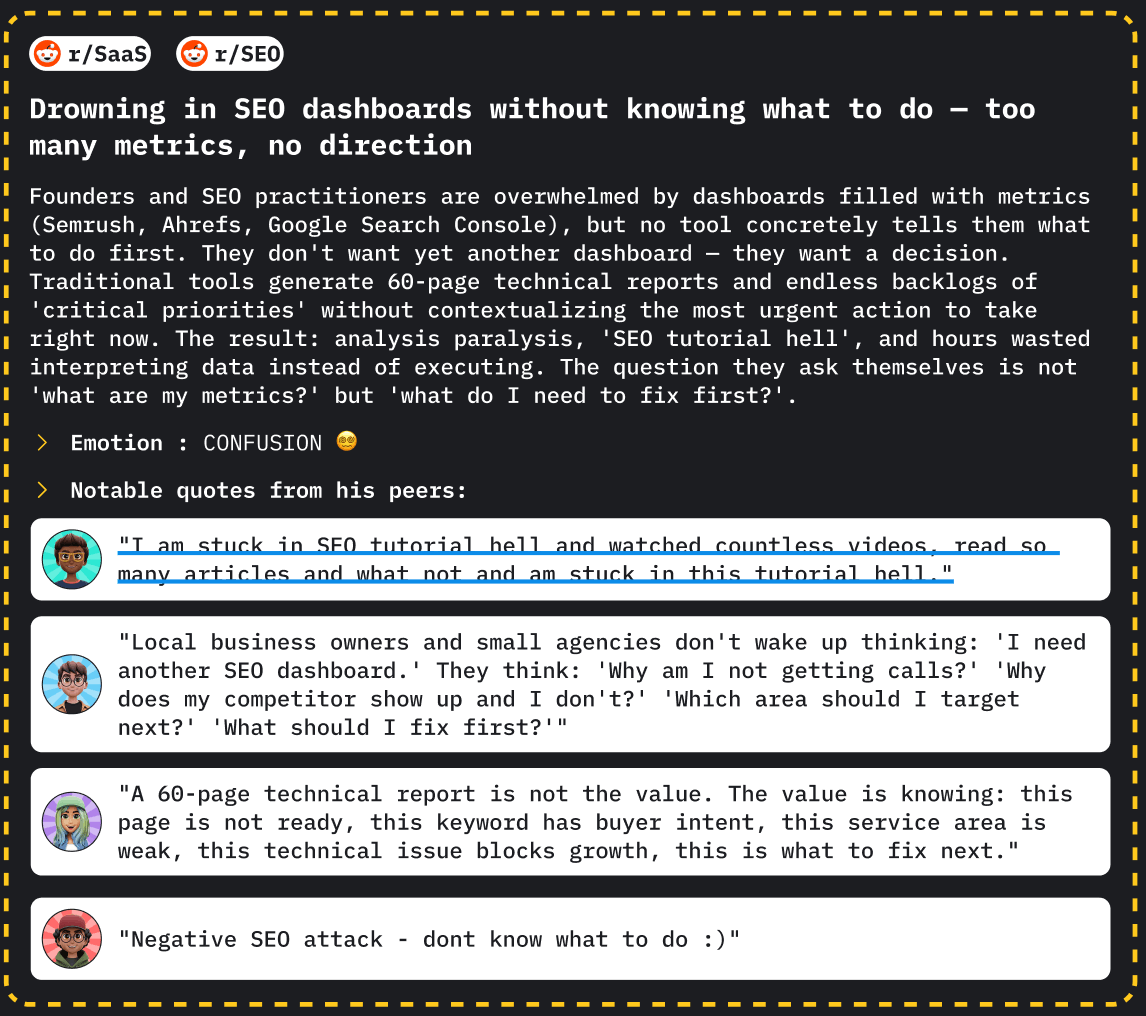
Martin’s peers don’t care about technical reports. They care about outcomes:
“I am stuck in SEO tutorial hell and watched countless videos, read so many articles and what not and am stuck in this tutorial hell.” [0]
“Local business owners and small agencies don’t wake up thinking: ‘I need another SEO dashboard.’ They think: ‘Why am I not getting calls?’ ‘Why does my competitor show up and I don’t?’ ‘Which area should I target next?’ ‘What should I fix first?’” [0]
“A 60-page technical report is not the value. The value is knowing: this page is not ready, this keyword has buyer intent, this service area is weak, this technical issue blocks growth, this is what to fix next.” [0]
The emotion here is pure confusion and fatigue [0]. The moment a software landing page starts talking about its own domain-specific terms (like “decisions” and “system loops”), Martin tunes out. He wants an expert to just tell him what to do [0].
Part 4: Reading the Page Through Martin’s Eyes
When we mapped Martin’s frustration against RankQuest’s original landing page, several structural and copy issues stood out:
- Internal Jargon over Customer Language: The copy heavily relied on terms like “Get One clear decision” and “system loops.” This is RankQuest’s internal logic, not the buyer’s language. The user wants expert advice, not to learn a new SaaS framework [0].
- Confusing Section Chronology: The flow was disjointed. The page presented features, comparisons, and warnings in a sequence that disrupted natural reading.
- Hidden Strengths: The concept of gamified “implementation rooms” (quests/dungeons) is a brilliant way to make tedious technical tasks fun, but this asset was buried and poorly explained.
- Pricing Repetition: Minor friction points, such as repetitive blocks in the pricing details and a confusing note about credit cards, diluted trust right before the conversion step.
Part 5: The Three-Way Review (Our Full Board)
We put Yoanna, Aymeric, and our AI specialist, Tim, to work on the wireframe. By aligning human psychology with AI linguistic modeling, we built a visual diagnosis of the page:
What’s already working
- Aymeric: “Adopting a gamified approach to SEO is very clever. It makes a daunting subject fun. I especially love the concept of quests and dungeons (implementation rooms) and avoiding endless, boring instruction tables.”
- Yoanna: “The product solves a major problem. Sections like ‘Built on signals you already trust’ (Google Search Console, PageSpeed Insights) establish great initial authority.”
- Tim: “The comparison section (‘From dashboards… to decisions’) is a strong structural element, but it needs to pivot away from introducing more definitions and move toward proving immediate value.”
What we’d review
- Yoanna: “The current order of sections is confusing and disrupts the flow. We need a cleaner, more logical layout that leads the user from frustration to solution step-by-step.”
- Aymeric: “You talk a lot about ‘decisions.’ That is your internal language. When a customer arrives on your site, they are looking for clear tasks, fixes, and expert direction. We need to speak their language.”
Yoanna’s Recommended Layout Chronology:
To resolve the cognitive friction, we proposed re-ordering the entire page using a narrative flow:
- Hero (The Hook)
- Demo Screenshot (The Proof)
- The Pain (Why dashboards are failing you)
- Comparison Chart (RankQuest vs. Traditional Noise)
- How it Works (The Loop: Observe -> Decide -> Fix -> Update)
- “What you actually get” (The gamified implementation rooms)
- Pricing (Clear, simplified plans)
- Who is it for? (Founder vs. Lean Team vs. Anti-persona)
- Final CTA (The closing pitch)
Part 6: The Hero We Shipped
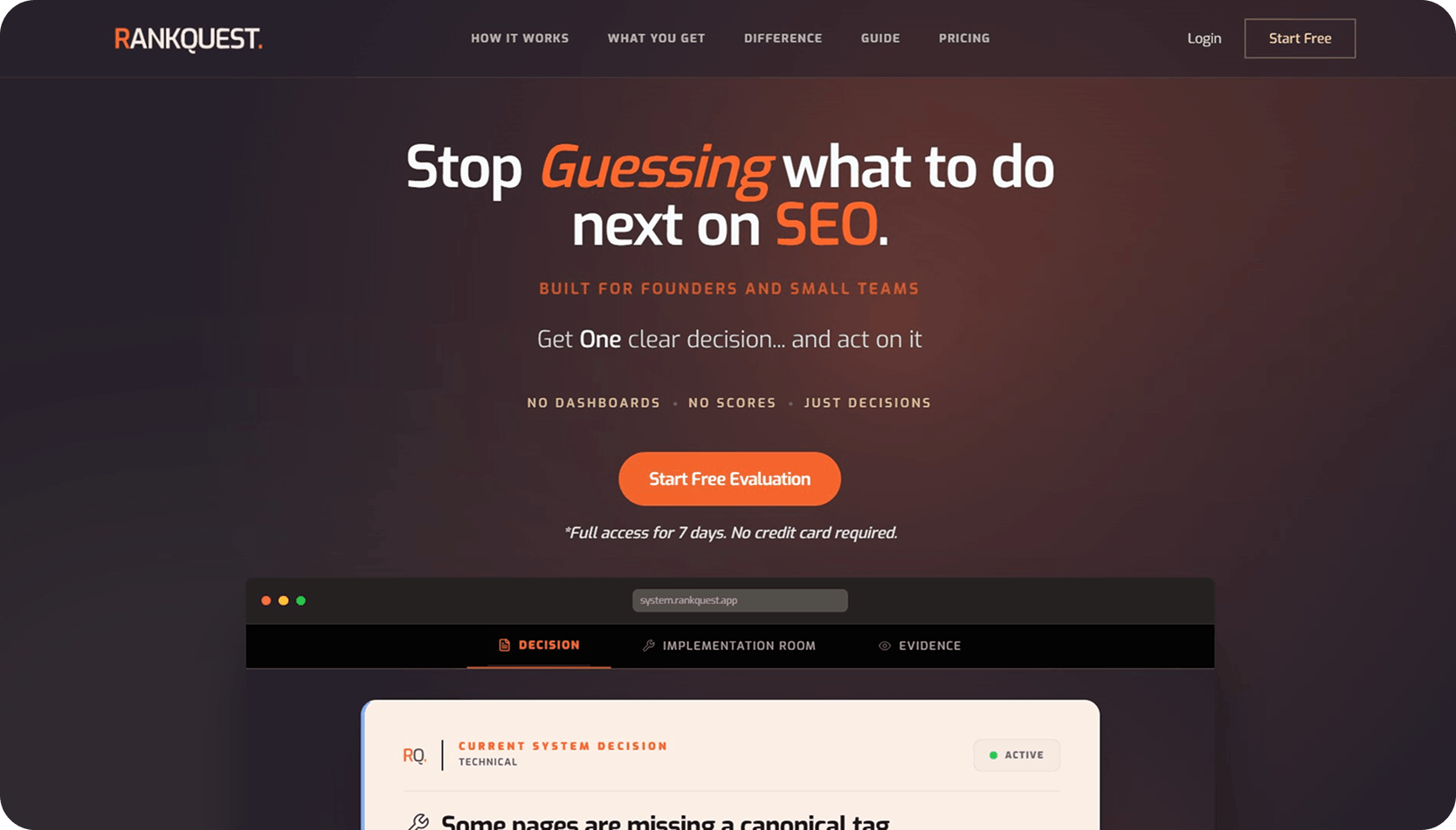
By changing the angle of the hero section, we stopped selling a tool and started selling an outcome. Here is the transformation:
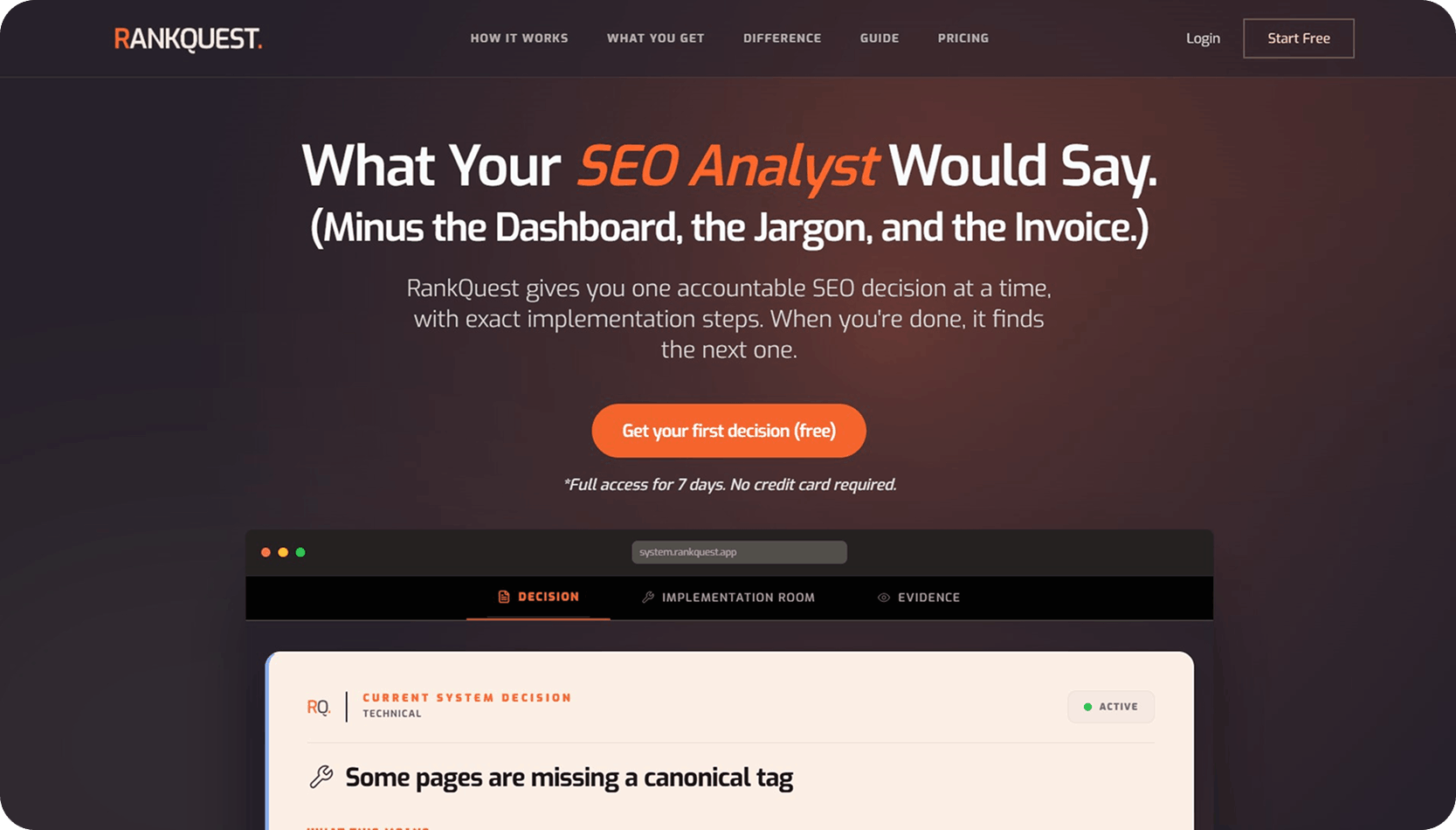
H1: What Your SEO Analyst Would Say.
(Minus the Dashboard, the Jargon, and the Invoice.) [0]Subhead: RankQuest gives you one accountable SEO decision at a time, with exact implementation steps. When you’re done, it finds the next one. [0]
Primary CTA: Get your first decision (free) [0] Microcopy: No credit card required · Full access for 7 days [0]
Why this works
- It anchors the price to a high-value alternative: An SEO consultant or agency analyst costs anywhere from €500 to €1,000+ per month. By framing RankQuest as “What Your SEO Analyst Would Say,” the $49/month price point instantly feels like an absolute bargain [0].
- It eliminates the fear of complex tools: The parenthetical line — (Minus the Dashboard, the Jargon, and the Invoice) — addresses Martin’s core dreads: complex dashboards, technical jargon, and expensive retainers [0].
- It promises a stress-free loop: The subhead clarifies that the user never has to figure out what to do next. You finish one step, and the system automatically serves up the next. You just execute [0].
- The CTA lowers the barrier to entry: Switching from “Start Free Evaluation” to “Get your first decision (free)” turns a vague trial commitment into a tangible, immediate reward [0].
See the Full Audit
We don’t deliver audits in long, boring PDFs. We deliver them as interactive, visually annotated Figma boards where you can see exactly where the copy is failing and how to fix it:
This feedback loop is built for execution. It helps developers and founders ship changes in hours, not weeks.
The Takeaway for Builders
If your software reduces a complex workflow into simple steps, do not write copy that makes your tool sound complex.
If you are saving your users from a high-ticket service (like a developer, designer, or SEO analyst), use that service as your anchor [0]. Compare your pricing to their invoices, and contrast your simplicity with their technical jargon [0]. Speak the words your customers write on forums when they are frustrated, and your conversion rates will follow.